
Sergio Cayuela · Madrid, Spain
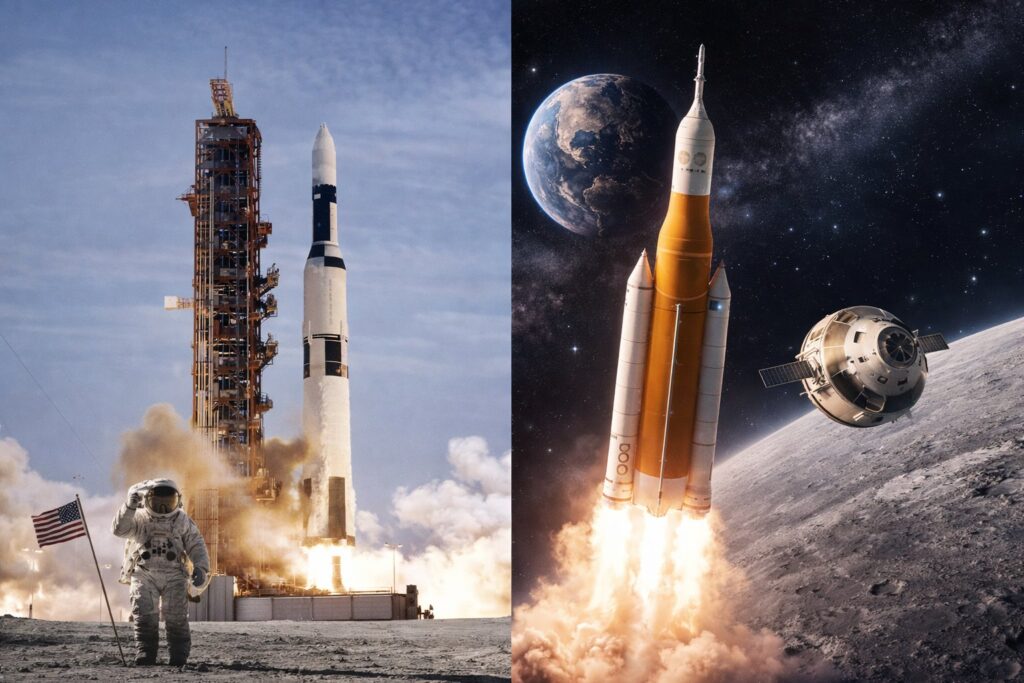
The Apollo Program enabled humanity to reach the Moon through a progressive and highly structured process. Before achieving success, the program faced a critical moment with Apollo 1, an accident during a ground test that led to a complete redesign of safety systems.
From that point on, each mission had a specific purpose: Apollo 4–6 validated the Saturn V rocket; Apollo 7 operated in Earth orbit; Apollo 8 carried astronauts to lunar orbit for the first time; Apollo 9 tested the lunar module; and Apollo 10 performed a full rehearsal, descending close to the lunar surface.
The turning point came with Apollo 11 in 1969, followed by further missions that consolidated lunar exploration, with a total of six successful landings. After Apollo 17 in 1972, the program was cancelled due to economic and strategic reasons.
The architecture was clear: a command module for return to Earth, a service module providing propulsion and life support, and a lunar module designed for descent to and ascent from the Moon’s surface.
More than 50 years later, the Artemis Program resumes this path with a different approach. Initial missions focus on returning to lunar orbit to validate systems, crew operations, and deep space navigation. In later phases, the objective is to return to the surface using new technologies and a more modular architecture, including multiple spacecraft, orbital docking systems, and international collaboration.
Unlike Apollo, Artemis is not only about repeating the achievement, but about laying the foundations for a sustained presence on the Moon, developing infrastructure in its environment, and using it as a stepping stone for future missions to Mars.
This process began with the Artemis I mission in 2022, in which the Space Launch System rocket and the Orion spacecraft carried out an uncrewed flight around the Moon to validate the entire system under real conditions. Following the success of this test, the next step will be the Artemis II mission, scheduled for April 1, 2026, with several launch opportunities in the days that follow, as this type of mission depends on very precise conditions and, if they are not met at that moment, the launch is rescheduled for the next available opportunity. During this mission, four astronauts will travel around the Moon as preparation for future missions in which they will once again land on the lunar surface.