
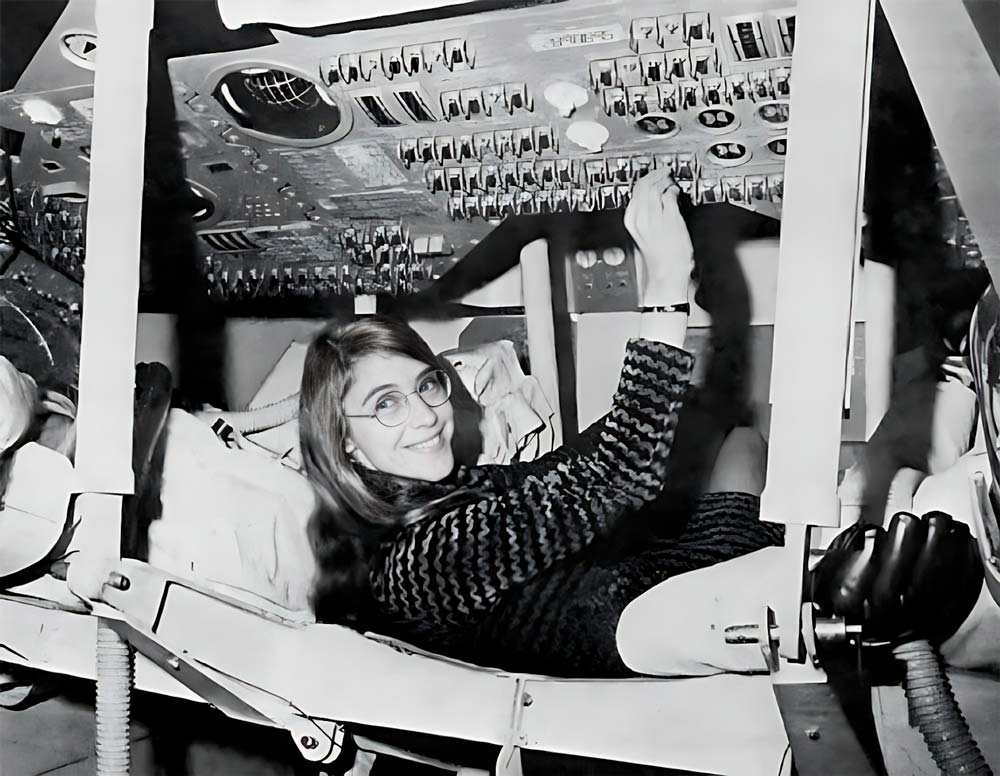
The pioneer who helped take humanity to the Moon and transformed the way we understand software engineering
Sergio Cayuela | Engineer | Noordwijk, Netherlands
Hay historias que merecen ser contadas
Human history is filled with great discoveries, technological advances, and events that changed the way we understand the world. Yet behind every one of these achievements are people whose names have not always received the recognition they deserve.
People who devoted years of their lives to research, learning, and overcoming challenges. Women and men who dared to explore uncharted territory and, through their talent, effort, and perseverance, turned seemingly impossible projects into reality.
With this first publication, Stories is born: a space within Ignibrum dedicated to discovering, sharing, and recognizing the lives and achievements of those who have contributed to progress in science, engineering, technology, and exploration.
I want to bring these people into the spotlight, spark curiosity about their achievements, and remind readers that behind every great breakthrough lies far more than technology: there is talent, dedication, and an extraordinary human ability to push beyond the boundaries of what is known.
I am writing these opening lines from Noordwijk, in the Netherlands, home to the European Space Research and Technology Centre (ESTEC) of the European Space Agency (ESA). It is a particularly meaningful place from which to launch this new section of Ignibrum, dedicated to rediscovering and sharing the lives of those who helped transform our understanding of the world.
Being here also holds personal significance for me. In 1967, my father, Francisco Cayuela, worked in this same country, at a Philips technology facility, at a time when electronics was beginning to transform the world. Almost six decades later, finding myself in the Netherlands through my own journey in engineering makes me reflect on how knowledge, experiences, and curiosity can connect generations.
Perhaps that is why this feels like such a special place to begin. Because behind great technological advances there are also memories, people, and experiences that, in one way or another, remain with us throughout our lives. And because recognizing those who came before us is also a way of better understanding the path we continue to follow today.
To inaugurate this space, I wanted to begin with one of the most extraordinary events of the twentieth century: humanity’s arrival on the Moon.
But this time, I do not want to talk about the astronauts who walked on its surface.
I want to dedicate these first pages to a woman who, from Earth, made a decisive contribution to turning that dream into reality.
Her name was Margaret Hamilton. And this is her story.
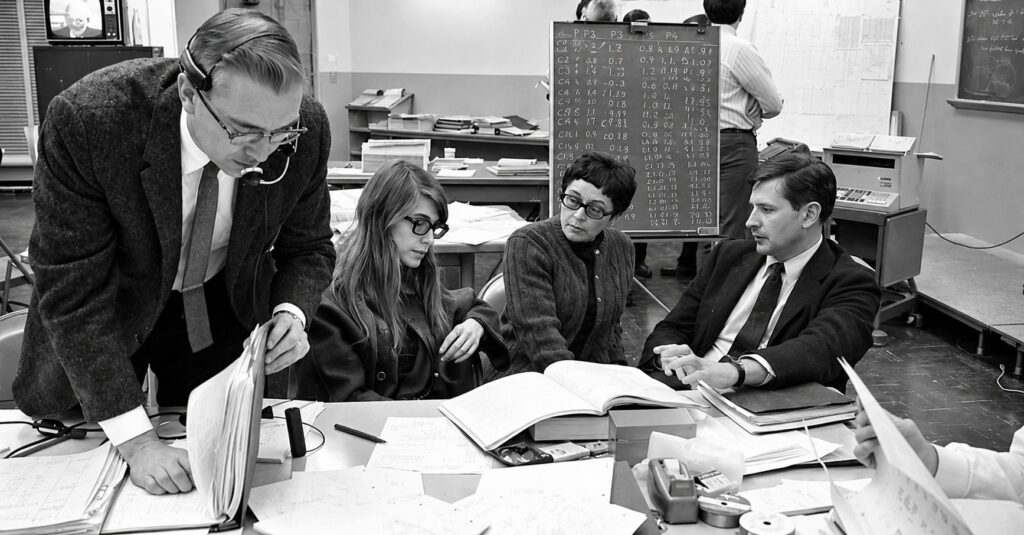
Margaret Hamilton with the Apollo 8 mission support team at the MIT Instrumentation Laboratory, 1968. Photograph: Courtesy of Margaret Hamilton.
The Day Humanity Reached the Moon
On July 20, 1969, millions of people watched with anticipation as the lunar module Eagle descended toward the surface of the Moon.
Neil Armstrong and Buzz Aldrin were about to take part in one of the most significant events in the history of space exploration. After years of preparation, research, and technological development, humanity was only minutes away from achieving a goal that, for centuries, had belonged to the realm of imagination.
However, during the descent, the guidance computer began generating unexpected alarms. Codes 1201 and 1202 indicated that the system was experiencing a processing overload.
The situation demanded quick decisions. The computer had to continue performing the essential operations required for the lunar landing, even though some of its processing capacity was being consumed by tasks that interfered with its normal operation.
Fortunately, the software had mechanisms capable of detecting the situation, recovering normal operation, and prioritizing the most important tasks.
That response was possible thanks to years of work by specialists at the Massachusetts Institute of Technology (MIT) Instrumentation Laboratory, including the team led by Margaret Hamilton.
The program’s ability to manage the situation, together with the actions of the astronauts and mission control teams, allowed the descent to continue.
Finally, Eagle landed in the Sea of Tranquility.
Humanity had reached the Moon.
As the world celebrated this achievement, thousands of scientists, technicians, and engineers could witness the result of an unprecedented collective effort.
Among them was Margaret Hamilton, a mathematician who had devoted much of her career to ensuring that computer systems could respond even to circumstances no one had expected to encounter.
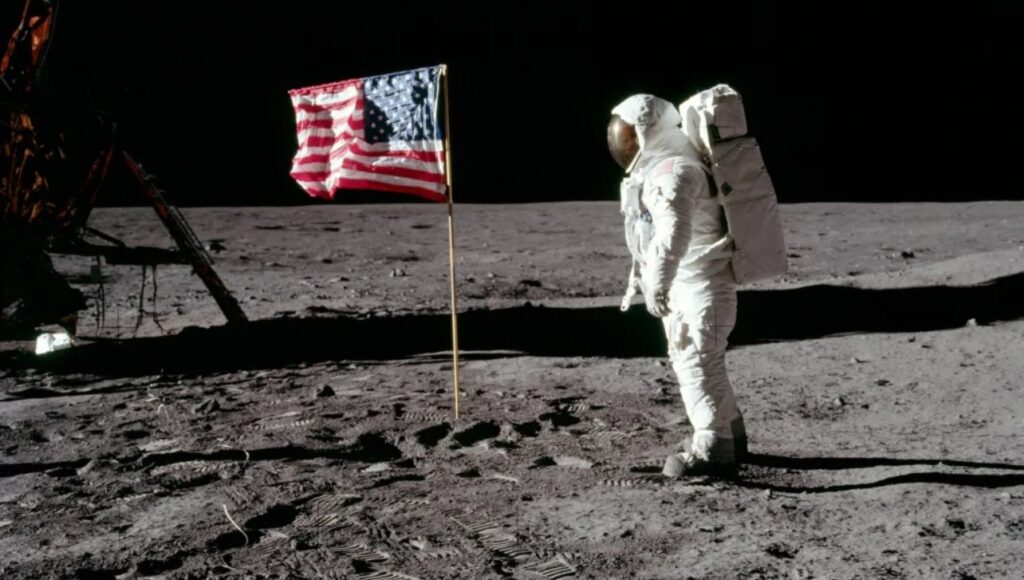
Buzz Aldrin beside the American flag during the Apollo 11 mission, 1969. Photograph: Neil Armstrong / NASA.
From Mathematics to Space Exploration
Margaret Elaine Hamilton was born on August 17, 1936, in Paoli, Indiana, United States.
Her academic education was closely linked to mathematics, a discipline that would profoundly shape her professional career. After studying at the University of Michigan, she completed her studies at Earlham College, earning a degree in Mathematics in 1958, with additional studies in Philosophy.
In 1959, she moved to Boston and began working at the Massachusetts Institute of Technology (MIT).
Margaret Hamilton’s connection to MIT also holds special meaning for me. My own time at this institution allowed me to experience an environment in which research, engineering, and innovation are part of a shared culture. It is an experience that now gives me a more personal connection to the journeys of people like Hamilton, who helped shape the institution’s history.
Her first professional experience there involved developing computer programs for weather forecasting under the direction of Professor Edward Lorenz, whose research would later contribute to the development of chaos theory.
That period marked her entry into a technological field that was still in the early decades of its development.
Computers at the time were enormous, expensive machines with extremely limited processing power compared with today’s technology.
Programming required a deep understanding of how they worked, the ability to operate with scarce resources, and the development of solutions to problems for which there were often no precedents.
Hamilton found in that environment an opportunity to apply her mathematical knowledge to entirely new challenges.
In 1961, she joined MIT Lincoln Laboratory, where she worked on the SAGE project, an American air defense system that used computers to process information and detect potential threats.
This experience sparked her interest in a question that would become one of the central themes of her career: software reliability.
How can we ensure that a computer system continues to function when an unexpected problem occurs?
That question would take on extraordinary importance when her professional path intersected with the Apollo space program.
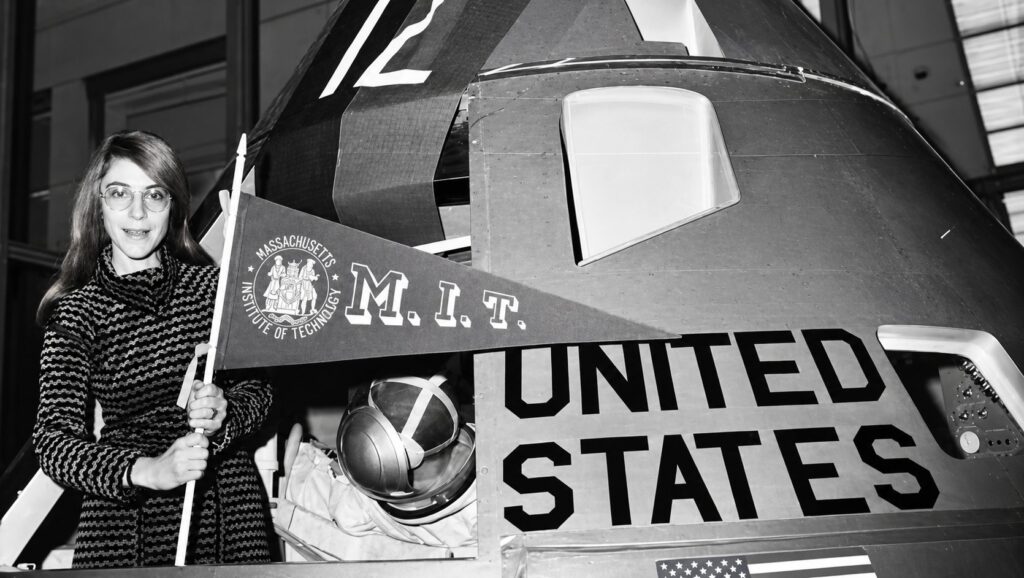
Margaret Hamilton beside a mock-up of the Apollo 12 command module, 1969. Photograph: MIT Photo Service / MIT Museum.
A Woman at the Heart of the Apollo Program
During the 1960s, the United States was immersed in an intense technological and space race.
President John F. Kennedy had established a goal that seemed to challenge the technical possibilities of the time: to send human beings to the Moon and bring them safely back to Earth before the end of the decade.
To achieve this, NASA needed to develop new technologies for navigation, communications, propulsion, and control.
Software became a fundamental part of that challenge.
Margaret Hamilton joined the MIT Instrumentation Laboratory to work on the development of computer programs for the Apollo project. She initially contributed to software for uncrewed missions and later assumed leadership responsibilities for the flight systems used in crewed missions.
She went on to lead the Software Engineering Division and became part of an organization that brought together hundreds of professionals dedicated to developing and testing the programs used aboard spacecraft.
The responsibility was extraordinary.
The computers used in the Apollo missions had very limited resources and were required to perform critical operations in an environment where any error could have irreversible consequences.
Furthermore, during a space mission, there was no possibility of stopping the journey to physically repair a computer or replace a faulty component.
Systems had to be designed to operate accurately, identify abnormal situations, and maintain essential operations when difficulties arose.
Hamilton understood that software had to be developed with the same rigor as any other fundamental component of a spacecraft.
It was not enough to ensure that a program worked correctly during testing.
Engineers also had to ask what would happen if conditions changed, if a failure occurred, or if someone made a mistake.
That approach to software development would become one of her most important contributions.
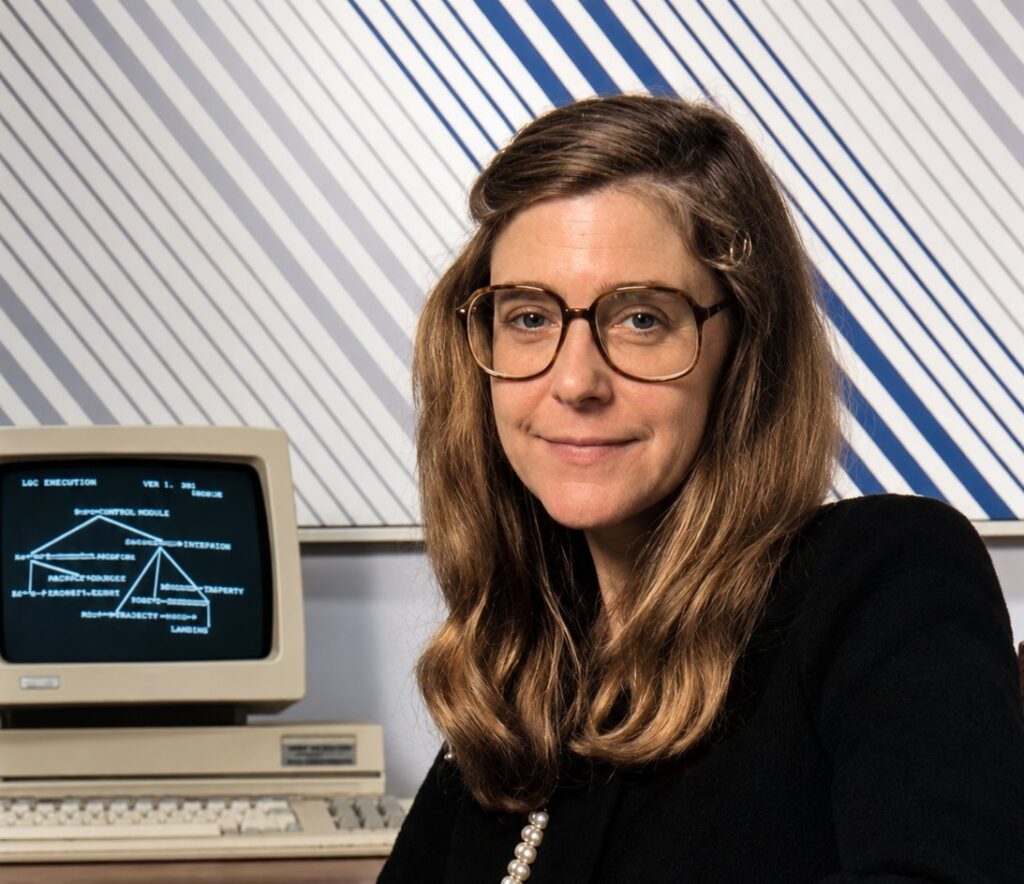
Margaret Hamilton, a pioneer of software engineering, in 1989. Photograph: NASA (attribution pending confirmation).
The Importance of Anticipating Errors
One of the best-known episodes of her career involves her daughter, Lauren.
During a visit to the laboratory, when she was still a young child, Lauren interacted with a flight simulator and activated a function that did not correspond to the phase of the mission being simulated.
Her action caused a problem in the system.
Hamilton then identified a situation she considered important: if a child could accidentally activate that function, there was also a possibility that an astronaut might make a similar mistake.
She proposed introducing safeguards to prevent certain operations from being executed at inappropriate times. Initially, however, it was considered that the astronauts’ training made such a modification unnecessary.
Some time later, during the Apollo 8 mission in December 1968, an incident occurred involving the accidental activation of a prelaunch function during flight.
The problem affected navigation information and required intervention from the ground team to restore the necessary data.
That experience confirmed the importance of an idea Hamilton had defended: even the most highly trained people can make mistakes.
Technological systems must be designed with that possibility in mind.
This principle is closely related to what we now call defensive programming and to methodologies intended to prevent, detect, and manage errors.
It is a lesson that remains fundamental in fields such as aerospace, industry, medicine, telecommunications, and space exploration.
Engineering is not simply about making something work. It is also about understanding what might go wrong and preparing to respond when it does.

Margaret Hamilton with her daughter Lauren during her work on the Apollo program, around 1969. Photograph: Unknown photographer..
When Software Became Engineering
Today, software engineering is a recognized discipline and an essential part of countless technological systems.
However, during the early years of computing, programming was not always regarded with the same professional standing as other branches of engineering.
The development of the physical components of computers attracted much of the attention, while software was still an activity whose scope and complexity were not fully understood.
Margaret Hamilton helped transform that perception.
She advocated the application of rigorous methods to software development, incorporating principles of design, verification, error prevention, and systems analysis.
She was also one of the figures who helped popularize the concept of software engineering, a term that contributed to recognizing the complexity and responsibility involved in this professional activity.
Her work on the Apollo program demonstrated that software could not be regarded as a secondary element within a technological project.
It was an essential part of systems on which critical operations and, in certain circumstances, human lives depended.
Her career continued long after the lunar missions.
In 1976, she founded Higher Order Software and, ten years later, Hamilton Technologies, companies associated with the development of methodologies and tools designed to improve the reliability of computer systems.
Her career demonstrates that her contribution went far beyond participating in a historic mission.
She also helped develop ideas and methods that would continue to influence engineering in the decades that followed.
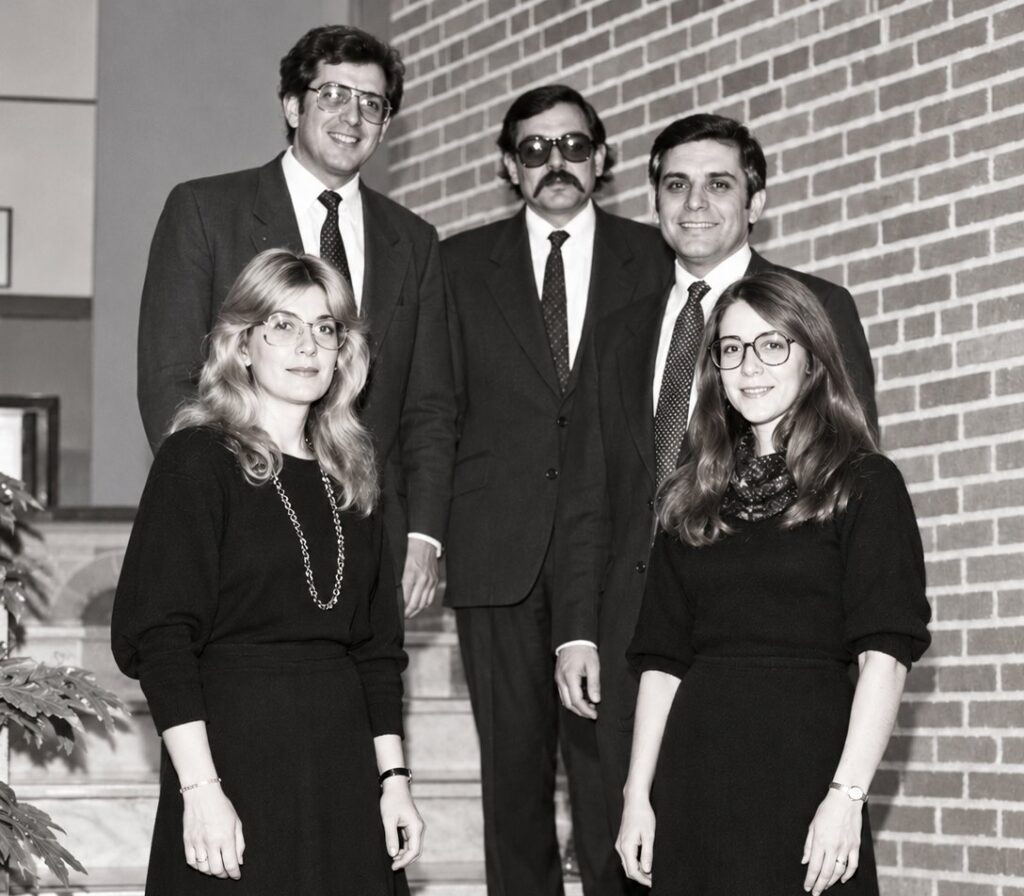
Margaret Hamilton and Saydean Zeldin in a brochure about Higher Order Design (HOD) software, 1970s. Image: NASA brochure / Wikimedia Commons.
The Photograph That Made an Extraordinary Contribution Visible
In 1969, a photographer at the MIT Instrumentation Laboratory took an image that, over the years, would become a symbol in the history of computing.
It shows Margaret Hamilton smiling beside an enormous stack of printed listings containing the software developed by her and the team she led for the Apollo missions.
The photograph is striking because of the sheer volume of documents beside her.
But its true value lies in what it represents.
Behind those pages were years of research, calculations, programming, testing, and collaborative work.
Every line of code formed part of an effort to solve technological problems that no one had previously faced in a mission of such complexity.
Today, more than half a century later, part of that extraordinary work can be explored by the public. The original source code for the Apollo 11 guidance computer has been digitized and made available on GitHub, where anyone can examine the programs used in the mission’s command and lunar modules.
Explore and download the Apollo 11 source code (GitHub): https://github.com/chrislgarry/Apollo-11
The image also invites us to reflect on the visibility of women throughout the history of science and technology.
For decades, numerous female mathematicians, programmers, scientists, and engineers participated in projects that were fundamental to human progress without always receiving the same public recognition as other leading figures.
Margaret Hamilton’s story reminds us that space exploration was the result of extraordinary collaboration among professionals from different disciplines.
Recognizing her contribution does not mean diminishing the importance of the astronauts or the other teams involved in the Apollo program.
It means understanding that an achievement of such magnitude could only become reality through the knowledge and efforts of thousands of people.
And that among those people were women whose work deserves a prominent place in our collective memory.
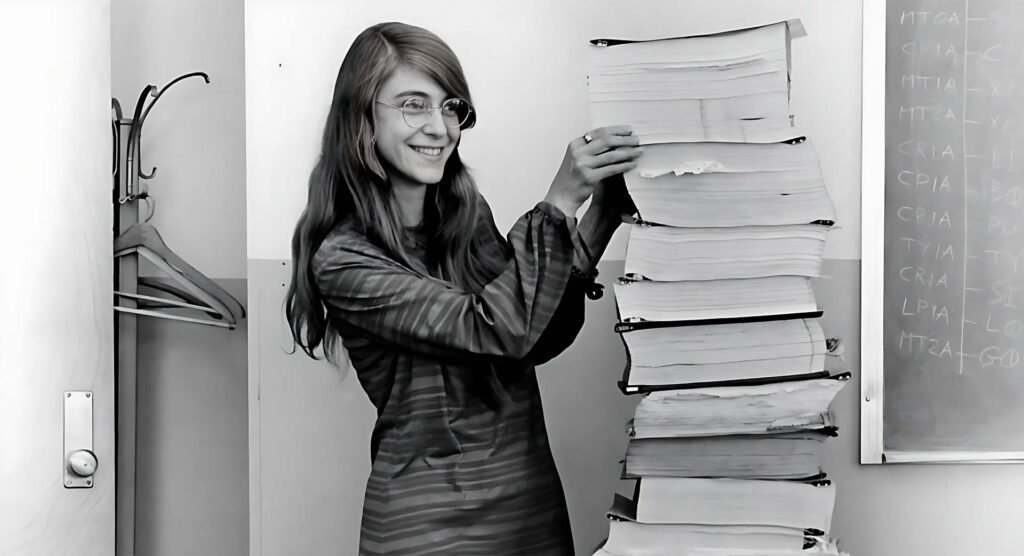
Margaret Hamilton beside the printed listings of software developed by her team for the Apollo program, 1969. Photograph: MIT Instrumentation Laboratory / MIT Museum.
Recognition That Transcended Generations
Over the years, Margaret Hamilton’s career began to receive increasing recognition.
In 2003, NASA presented her with the Exceptional Space Act Award for her scientific and technical contributions to the space program.
In 2016, she received the Presidential Medal of Freedom from President Barack Obama, one of the highest civilian honors in the United States.
She subsequently received further recognition for her contributions to computing and engineering, including her induction as a Fellow of the Computer History Museum in 2017.
Margaret Hamilton passed away on September 30, 2026, at the age of 90. Her death, announced several days later by the Massachusetts Institute of Technology (MIT), marked the end of an extraordinary life dedicated to knowledge, innovation, and engineering. Her legacy, however, lives on in the technological advances she helped make possible and in the generations that continue to find inspiration in her career.
But her legacy cannot be measured through awards alone.
It is also present in the evolution of a professional discipline that is now indispensable to the functioning of our society.
In computer systems that must respond to unexpected situations.
In methodologies designed to prevent errors before they occur.
In generations of engineers who have found in her career an example of perseverance, knowledge, and leadership.
And especially in the girls and young women who discover through stories like hers that they, too, can take part in the great scientific and technological challenges of the future.
Because the most lasting recognition is not always found in a medal or a photograph.
Sometimes it lives on in the people who decide to keep learning, researching, and building because of the example set by those who came before them.
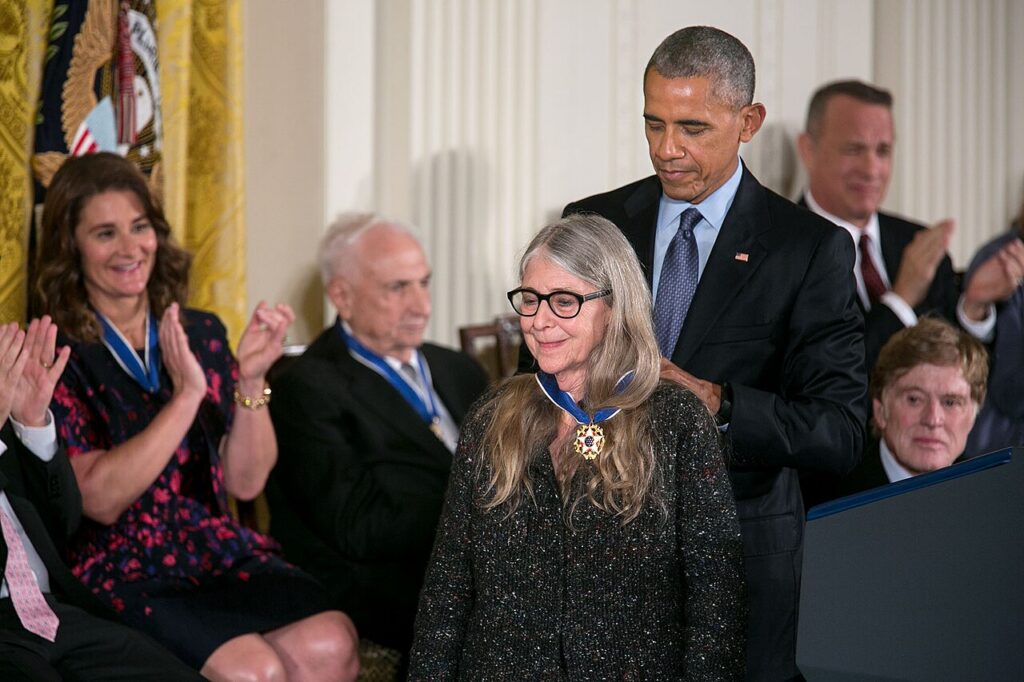
Barack Obama presents Margaret Hamilton with the Presidential Medal of Freedom at the White House on November 22, 2016. Photograph: Lawrence Jackson / White House.
Margaret Hamilton’s Legacy: Far Beyond the Moon
Margaret Hamilton’s story represents far more than a contribution to the Apollo program.
It is a story of knowledge, responsibility, perseverance, and confidence in humanity’s ability to solve extraordinarily complex problems.
It reminds us that great advances do not emerge from a brilliant idea alone. They require years of preparation, collaboration, learning, and people willing to take on challenges whose outcomes remain uncertain.
It also invites us to reflect on the importance of recognizing talent regardless of gender.
Science and engineering have advanced thanks to the work of countless professionals, many of whom have not received the visibility they deserved.
Rediscovering their stories does not mean changing the past, but understanding it better.
It means recognizing that scientific and technological progress has always been a collective achievement and that acknowledging all its contributors allows us to offer more diverse role models to future generations.
Margaret Hamilton deserves to be remembered for her own achievements, her professional abilities, and an approach to engineering that remains as relevant as ever.
At Ignibrum, we believe that sharing stories like hers is also part of our responsibility to knowledge.
Because engineering is not only about developing technologies, building machines, or solving technical problems.
It is also about imagining possibilities that do not yet exist and working to turn them into reality.
And that ability belongs to everyone who feels curious, who dares to learn, and who sees difficulties as opportunities to keep moving forward.
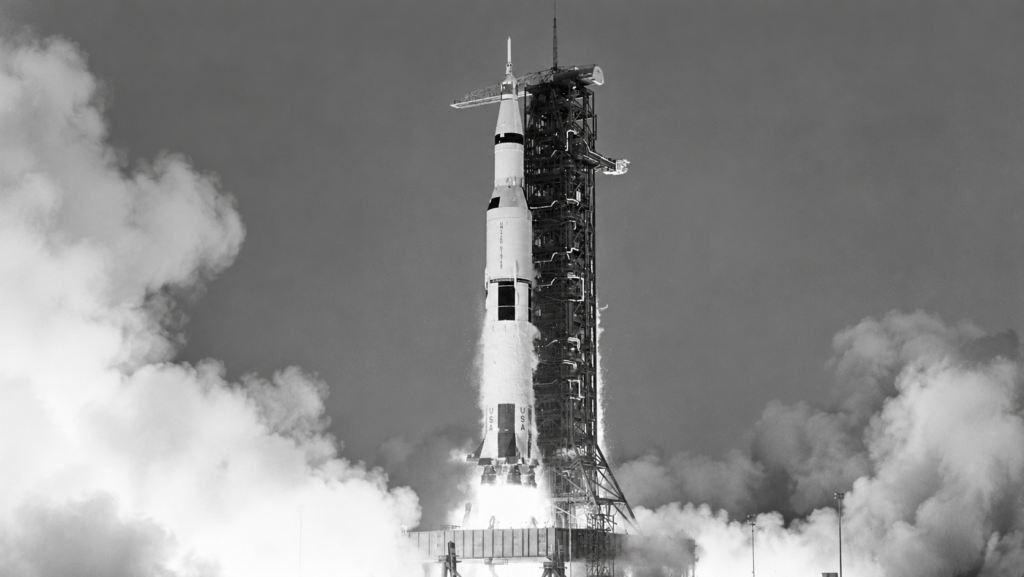
Launch of the Apollo 11 Saturn V rocket from Kennedy Space Center on July 16, 1969. Photograph: NASA
A Story That Deserves to Remain Among the Stars
astronauts, Neil Armstrong’s words, and the silhouette of the Eagle lunar module on the Sea of Tranquility.
But behind those images were thousands of stories that also deserve to be told.
Margaret Hamilton’s is one of them.
The story of a mathematician who began by developing weather forecasting programs and went on to lead a team whose work helped make one of the greatest achievements in space exploration possible.
The story of a professional who helped transform the way we understand software and its importance within technological systems.
The story of a woman who demonstrated that knowledge, preparation, and perseverance can open paths where uncertainty once seemed to be the only possibility.
Margaret Hamilton never walked on the Moon. But she helped build the path that allowed humanity to reach it.
Her contribution remains part of the history of engineering and continues to serve as an example to those preparing to face new challenges today.
Because great dreams do not belong only to those who manage to achieve them.
They also belong to those who make it possible for others to go further.
At Ignibrum, we dedicate this first story to Margaret Hamilton and to all the women whose talent, effort, and determination have contributed to progress in science, technology, and engineering.
Because recognizing their legacy is also a way of inspiring those who will build the future.
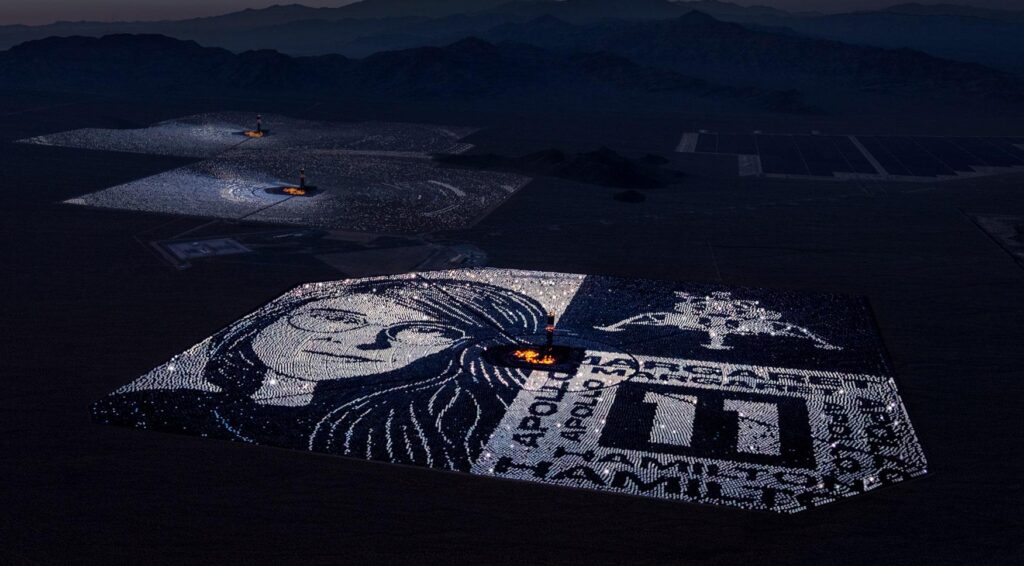
Tribute to Margaret Hamilton in California’s Mojave Desert in 2019, marking the 50th anniversary of Apollo 11. Her portrait was recreated using more than 107,000 mirrors reflecting moonlight. Image: Google Creative Lab.
Sources and References
MIT News
- Chandler, D. (2009). Recalling the “Giant Leap”. https://news.mit.edu/2009/apollo-vign-0717
- Weinstock, M. (2016). Scene at MIT: Margaret Hamilton’s Apollo code. https://news.mit.edu/2016/scene-at-mit-margaret-hamilton-apollo-code-0817
- MIT. (2016). Apollo code developer Margaret Hamilton receives Presidential Medal of Freedom. https://news.mit.edu/2016/apollo-code-developer-margaret-hamilton-receives-presidential-medal-of-freedom-1117
- Liberty, J. (2026). Margaret Hamilton, computing pioneer who led software development for the Apollo program, dies at 90. https://news.mit.edu/2026/margaret-hamilton-computing-pioneer-dies-1007
NASA and Historical Archives
- NASA (2003). NASA honors Apollo engineer. https://www.nasa.gov/wp-content/uploads/static/history/alsj/a11/a11Hamilton.html
- NASA. Apollo 11. https://www.nasa.gov/mission/apollo-11/
- MIT Museum. Historical collections https://mitmuseum.mit.edu/
Código fuente original del Apolo 11
- Garry, C. L. Apollo-11 — Source code for the command and lunar module. https://github.com/chrislgarry/Apollo-11
- Virtual AGC. Apollo Guidance Computer. https://www.ibiblio.org/apollo/
Photographic Credits and Licenses
Historical photographs are identified in their respective captions. Images from NASA and other institutions are used in accordance with the conditions applicable to each individual file.
The photograph of Margaret Hamilton beside the Apollo software listings, held by the MIT Museum (GCP-00009689), is available under the CC BY-NC 4.0 license. Required credit: Courtesy MIT Museum.
Sources and terms of use:
- NASA: https://www.nasa.gov/nasa-brand-center/images-and-media/
- MIT Museum: https://mitmuseum.mit.edu/collections/object/GCP-00009689
- Creative Commons: https://creativecommons.org/licenses/by-nc/4.0/
Third-party images remain subject to their respective rights and conditions of use. Their inclusion does not imply any affiliation, sponsorship, or institutional endorsement of Ignibrum.
Authorship and Copyright
© 2026 Sergio Cayuela · Ignibrum. All rights reserved.
Original article by Sergio Cayuela, published in Stories, the editorial section of Ignibrum.
Unauthorized reproduction, distribution, or adaptation of the original text, in whole or in part, is prohibited except where permitted by applicable law. Photographs and other third-party materials remain subject to their respective copyrights and terms of use