
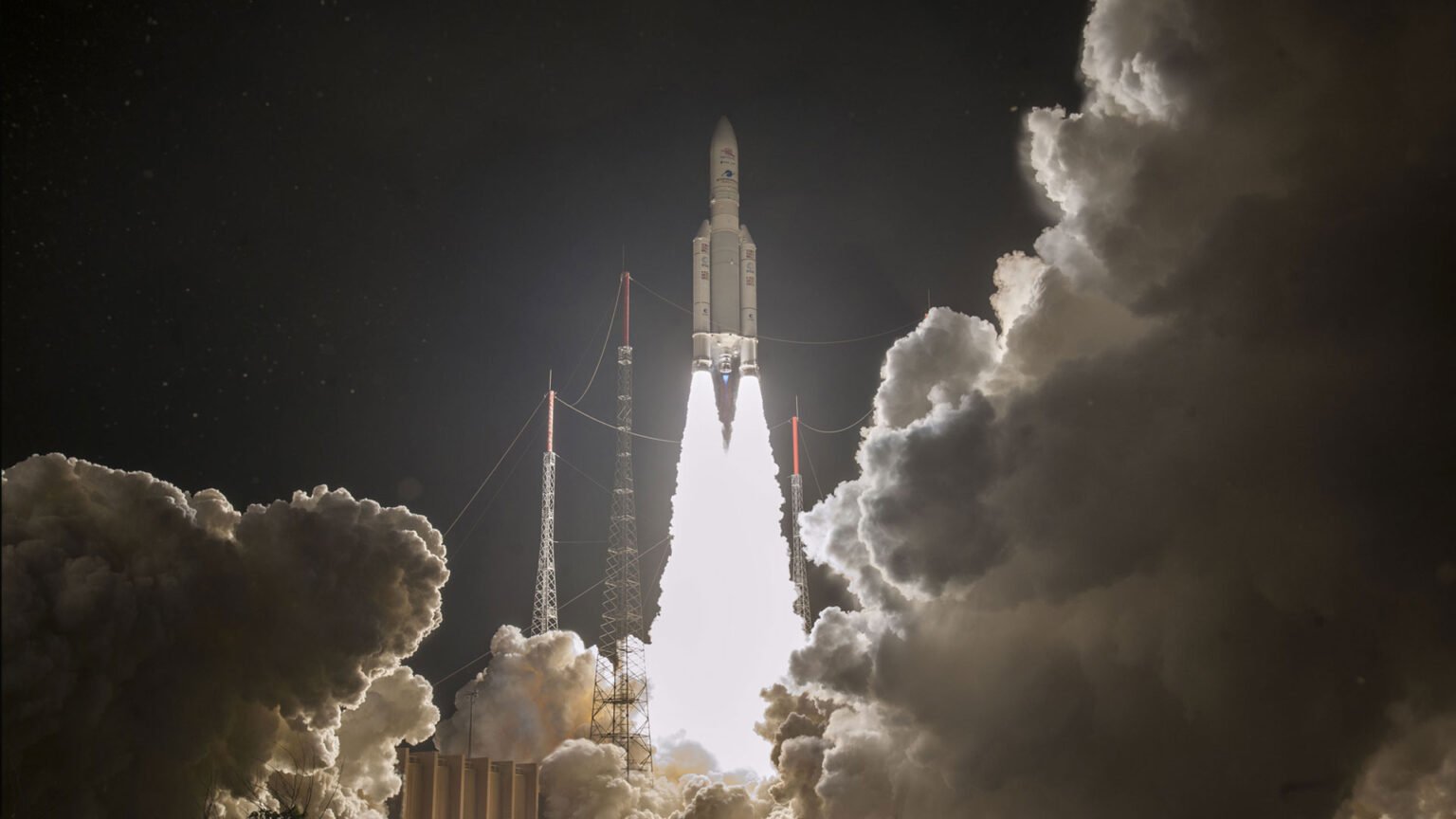
n 20 October 2018, an Ariane 5 lifted off from Europe’s Spaceport in Kourou with two probes on board. The European probe, MPO, would study Mercury’s surface and interior. The Japanese probe, Mio, would measure how the planet’s magnetic environment responds to the solar wind. Together they formed BepiColombo, a joint mission by the European Space Agency (ESA) and the Japan Aerospace Exploration Agency (JAXA). Eight years later, the two spacecraft have entered Mercury orbit while still joined together.
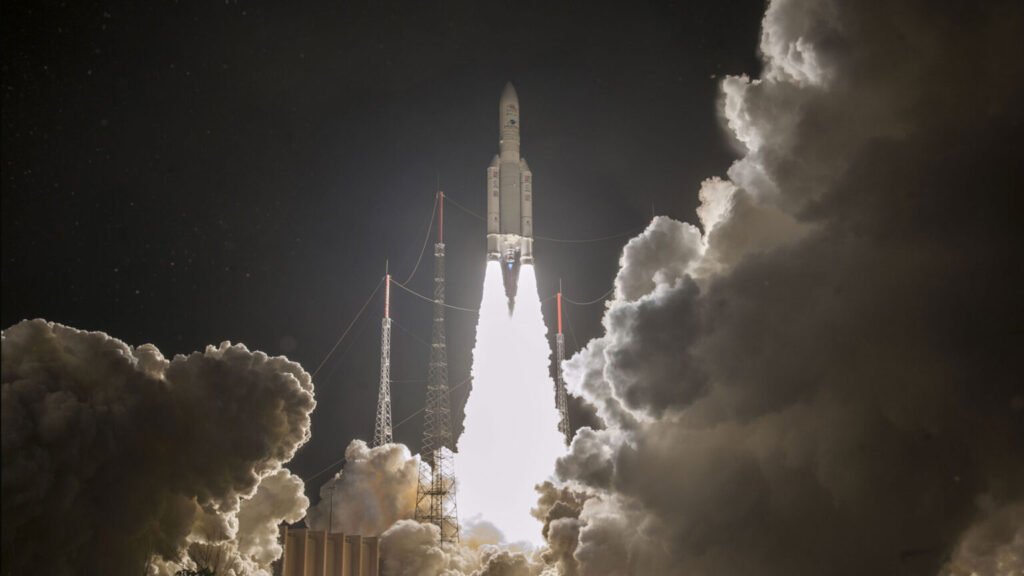
An Ariane 5 carrying the BepiColombo mission lifts off from Europe’s Spaceport in Kourou on 20 October 2018 (UTC).
Photo credit: © 2018 ESA-CNES-Arianespace.
Spain’s Contribution to BepiColombo
Spain contributed to the mission both aboard the spacecraft and from the ground. Airbus Crisa developed equipment that manages the spacecraft’s power supply and powers its electric thrusters. Sener contributed to the antenna system used to communicate with Earth. At Cebreros, in Ávila, ESA’s deep-space antenna received the telemetry that mission control used to monitor one of the manoeuvres ahead of the arrival at Mercury.
Six Flybys Before Entering Orbit
BepiColombo flew past Earth once, Venus twice and Mercury six times. Each flyby helped adjust its trajectory. The challenge was to arrive slowly enough relative to Mercury for the planet’s gravity to capture the probes. The mission is named after Giuseppe “Bepi” Colombo, the Italian engineer and mathematician who helped NASA design the trajectory that took Mariner 10 past Mercury three times in the 1970s.
What Einstein Has to Do with Mercury
In 1915, Albert Einstein used general relativity to explain a small shift in Mercury’s orbit that Newtonian calculations had left unexplained. More than a century later, BepiColombo will test another prediction of that theory. The team will send a radio signal from Earth to the European spacecraft, which will transmit it back. When the signal passes close to the Sun, the curvature of spacetime delays it slightly. The MORE experiment will allow the team to compare the measured delay with the theory’s prediction.
The two probes will separate in December. MPO will descend into a lower orbit to study Mercury’s surface and large metallic core. Mio will remain in a more elongated orbit to observe how the solar wind disturbs the planet’s magnetic environment. Simultaneous measurements from two locations will help distinguish a local disturbance from one that extends across a wider region. Science operations are scheduled to begin in April 2027.
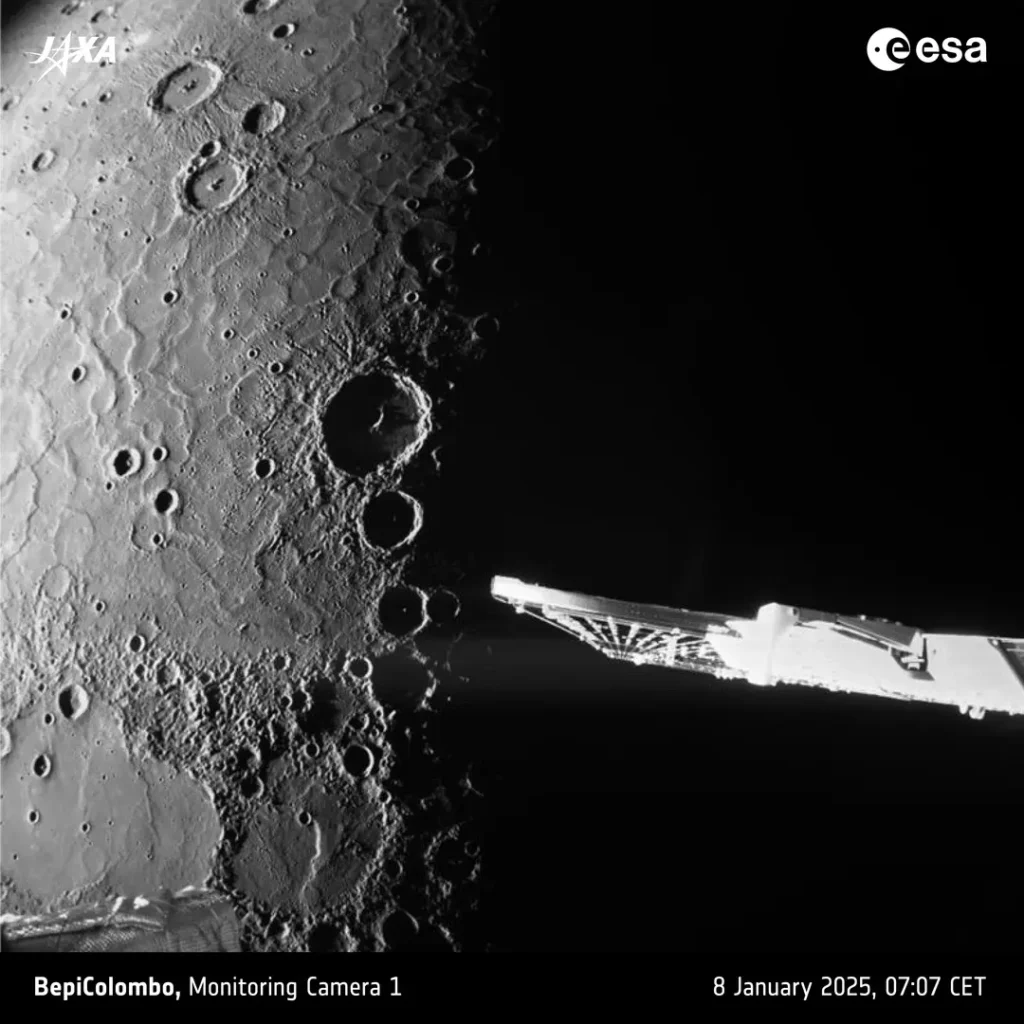
Mercury’s north pole, photographed by BepiColombo’s M-CAM 1 camera during its sixth flyby on 8 January 2025. Credit: ESA/BepiColombo/MTM · CC BY-SA 3.0 IGO.