
Sergio Cayuela · NYC, EE.UU
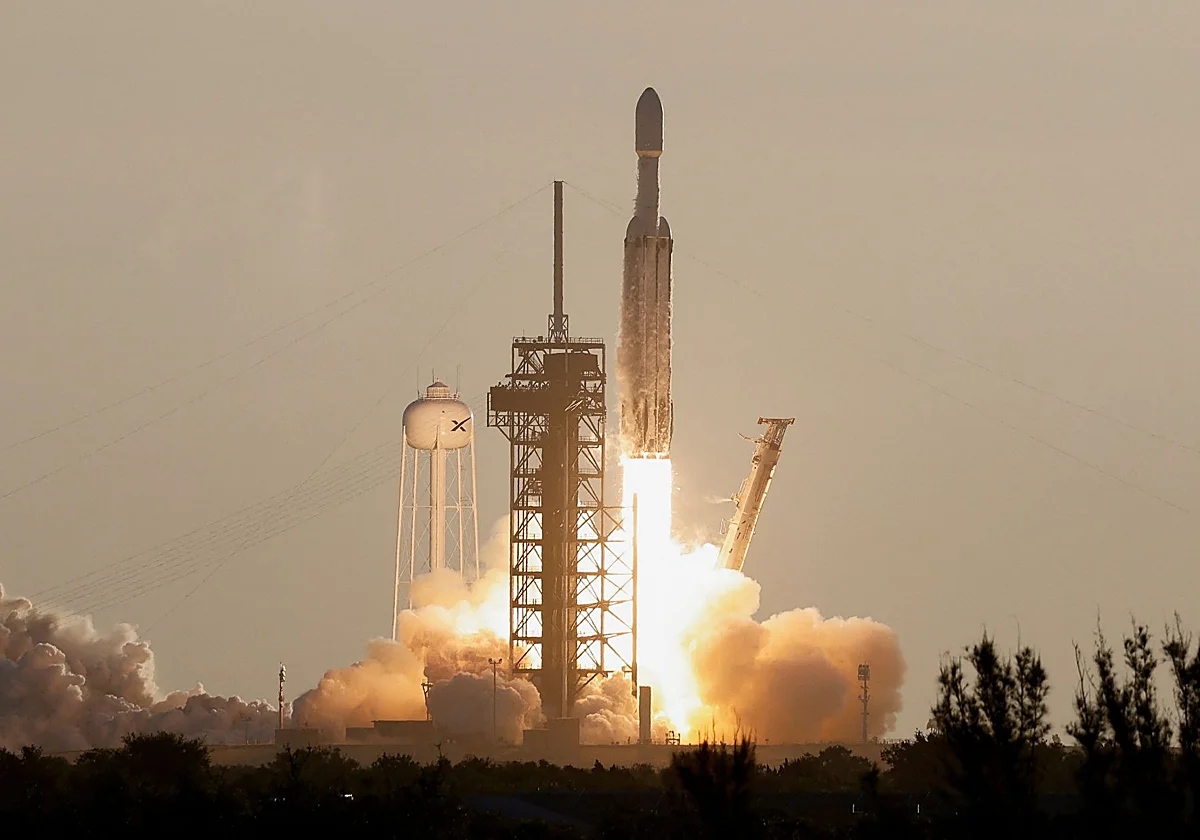
NASA has successfully launched the Nancy Grace Roman Space Telescope aboard a SpaceX Falcon Heavy rocket. The observatory is now travelling towards its orbit around the Sun–Earth L2 Lagrange point, approximately 1.5 million kilometres from Earth, where it will begin one of the most extensive explorations of the universe ever undertaken.
Its primary objective is to investigate the so-called dark universe. Ordinary matter—stars, planets and everything we can observe directly—accounts for only around 5% of the cosmos. The remainder is thought to consist of dark matter and dark energy, two invisible components whose true nature remains one of the greatest mysteries in physics.
Roman will observe hundreds of millions of galaxies and analyse how they are distributed and how their motion has evolved over cosmic time. Using techniques such as gravitational lensing and the observation of supernovae, it will create large-scale maps of dark matter and measure the accelerated expansion of the universe with unprecedented precision. Its findings could help determine whether our current cosmological theories are correct—or whether modern physics itself needs to be revised.
The telescope will also conduct an extensive census of planets beyond our Solar System. It will search for exoplanets using gravitational microlensing and transit observations, including worlds orbiting far from their stars and even rogue planets travelling alone through the galaxy. Its coronagraph will also block the intense light of selected stars, allowing scientists to attempt to image some of the planets orbiting them directly and study their characteristics.
Roman’s main camera, capable of observing in visible and near-infrared light, will combine high resolution with an extraordinarily wide field of view. This will allow it to examine vast regions of the sky and detect galaxies, black holes, supernovae, stars, asteroids and other phenomena that change over time.
Roman’s true impact will lie in its scale. It will do far more than capture spectacular images: it will generate an immense public database that will enable the scientific community to reconstruct the evolution of the universe, better understand what it is made of and discover how common other planetary systems may be.

Credit: NASA